

Recently I saw and shared an Instagram video from Craig “SouthNarc” Douglas of Shivworks. It’s safe to say that Craig and Shivworks represent the gold standard of close-quarters self-defense training. When Craig has something to say, it’s wise to listen.
I’ve taken Craig’s Extreme Close Quarters Combat class twice. It was easily among the most demanding of the classes I’ve taken. I remember saying, at the end of one of those classes, that there was nothing enjoyable about it. On the contrary; it was hard, necessary work. Lessons I learned in those classes have even come to mind when I needed them in emergencies, most recently when I was confronted by an attempted mugging in the parking lot of a bookstore.
What I’m getting at is that Craig has the experience and a proven track record when it comes to instruction in these matters. His feedback and input are more than simply an “interesting opinion.” They are an informed opinion.
Craig Douglas on Social Media Knife Demos
It was therefore with great interest that I watched Craig expound on the topic of the various knife demos he was seeing on social media. I’ve indulged in videos of this type myself; I see them constantly; I enjoy watching them. Craig, however, had some very sobering things to say about the realism and the application of the techniques in these videos. His video is here.

In the clip, Craig describes the difficulty in manipulating a relatively small knife handle under stress while dealing with a resisting opponent. Knives, he explains, are easy to drop. He’s seen many a dropped knife in the classes he teaches on the topic.
Next, he addresses the notion of using a knife preemptively. So many of the knife demos he sees online are essentially “ambush” videos, in which a knife-armed exponent jumps on an unarmed BOB. The knifer then attacks a variety of small targets, nerve bundles, and arteries in combination and sequence.
Craig points out that it’s very hard to hit such targets when a human being is fighting back. He further questions the context of such demonstrations, saying, “There are not too many situations where you’re going to be able to preemptively ambush someone with a contact weapon.” The more likely scenario, Craig explains, is that you’re going to be struck or attacked and then have to deploy your knife, possibly while already reeling from some sort of trauma.
Yes, he explains, we should preempt and seize the initiative in an encounter, but doing so with a lethal contact weapon is far-fetched, in his opinion. That, the use of “sleight of hand” in knife demos, and hitting small targets on a resisting opponent seem to be his three major criticisms (after the notion of ambushes). Let’s tackle those one at a time, taking the last one first.
Will You, In Fact, See It Coming?
Are we, in fact, training to ambush the opponent? Does the proliferation of videos in which a standing BOB is mercilessly stabbed, out of context, point to this? I don’t actually think so, but you’d never know it from the videos themselves. You see, there’s an unspoken context here — a kind of collective expectation on the part of those making solo knife demos that the viewer will read our minds. I do it myself; I assume the viewer will in turn assume that we’re watching an exercise. That exercise is itself representative of the “action” part of the encounter, something that comes after all attempts to deescalate have failed and the aggressor has given sufficient provocation to escalate to lethal force.
There’s no way for the viewer, logically, to know that, though. Take Piper knife fighting, for example. There’s a HUGE blind spot in much of Piper in that no attempt is made, in the system as taught, to address deploying the weapon. This makes sense, given the provenance of Piper as a “criminally derived” system. Criminals choose the time and place of their attack, so their knives are already out and ready to go. All Piper training that I have experienced takes place with the knife already ready. There is nothing in the curriculum (at least in Western Piper Methods) that addresses drawing or opening the knife.
CORRECTION: I heard from WPM instructor Bryan Cannata concerning this. He pointed out, “We do teach drawing in all three levels of WPM. We teach it as range based, give examples, and let the student work it out as dictated by how they carry.” This is an entirely reasonable approach.
This reality demands we ask another question: What are the chances you’ll have time to deploy your knife BEFORE you end up fighting for it?
I’ve taken a class in Rochester, NY, that was devoted specifically to grappling with, and fighting to draw while grappling, folding knives. This was important, foundational material. The real irony, though, is that the only times I’ve ever drawn a knife for self-defense (or thought I might), I had plenty of time to see the threat coming. In the most extreme case, as two men closed on me in a dark parking lot at night (as I was leaving a movie that ended late), I had time to draw my knife from my waistband, open it, flip it to reverse grip, and then wait, questioning my life choices, as the two continued to close.
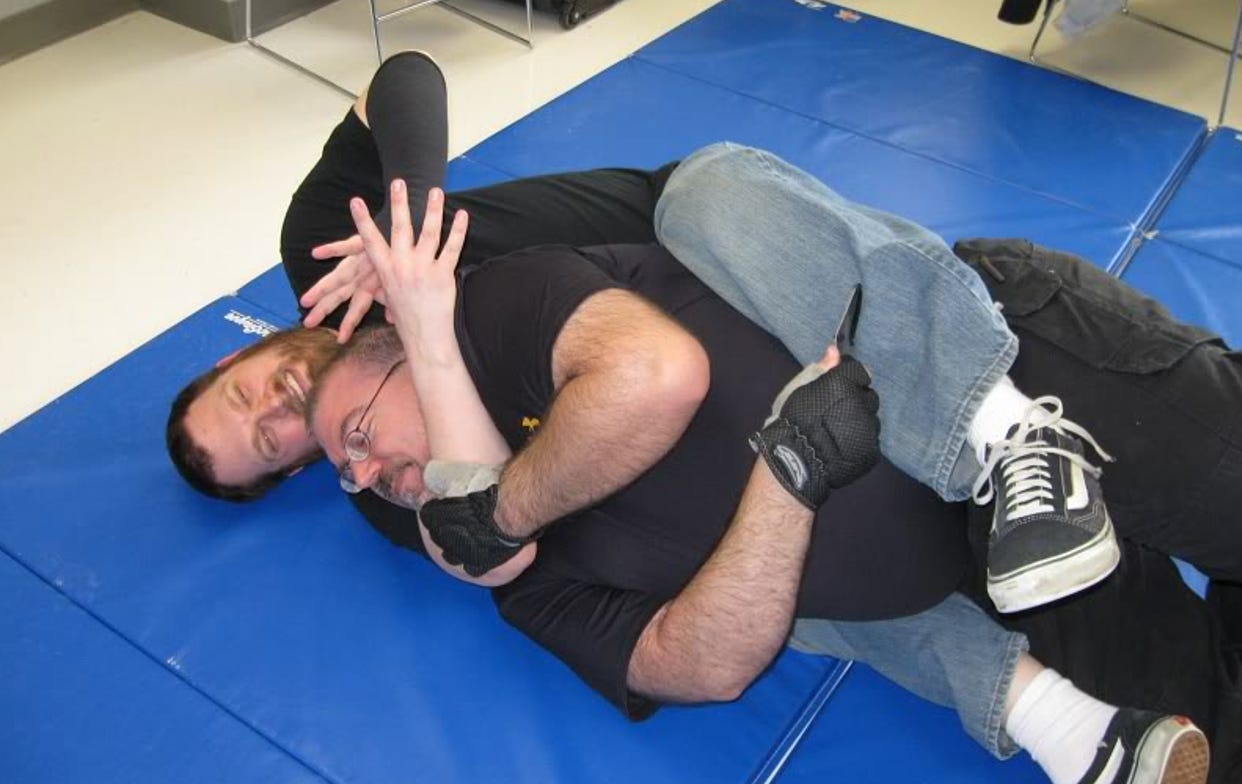
My “attackers” — which I believe they were — turned a sudden 90-degree angle and went away. I’ll never know if it was my imagination or if they truly did mean to mug me. That’s the best possible outcome. But it does represent a real-life incident in which I, the defender, had time to draw before a conflict occurred.
Still, Craig’s description of how a self-defense situation would work is much more likely to occur. We cannot train for low-percentage possibilities, even though Murphy’s Law dictates they will occur. We can and should be training for the more likely, higher-percentage threats. I’d like to hope that people who film solo knife demos are also aware of this and making provisions for it. Some of them, no doubt, aren’t.
Sleight of Hand
This one is less debatable. When Craig criticizes the notion of sleight of hand in knife videos, he’s referring to a variety of close-to-the-body knife manipulations that are dangerous under threat and which have little utility beyond “looking cool.” Danilo Rossi Lajolo di Cossano exemplifies this; his system, which I find aesthetically fascinating, involves a metric ton of such useless flourishes.
There are also a lot of Piper people, especially the “original flavor” South African Piper folks, who spend a lot of time doing extreme sleight-of-hand knife flipping, knife “folding” (meaning over the forearm or wrist, not closing the knife), and other extreme-dexterity moves. (They aren’t alone.)
What these close-in dexterity moves all have in common is that they’re dangerous to the user. The more you manipulate that sharp blade next to your own flesh, the greater the possibility you’ll injure yourself under stress. If you are reading this, you are well aware of the effects of adrenaline on your fine motor skills. When stress turns you into a lobster-clawed goon and your balls start crawling back up into your abdomen (if you’ve felt it, you know), that’s a bad time to start folding your knife blade over your forearm.
Then there is a special breed of stage magic as applied to knife manipulation. “Knerdy Knives” on Instagram probably best represents this trend (although he seems to spend more time bickering with his “haters” than he does selling brief clips of his knife manipulations). I even purchased one of these, thinking it was a full-length DVD, and discovered to my disappointment that it was a clip only a couple of minutes long. He graciously refunded my money.
There’s no “tactical” application of these tricks. Most of them accomplish nothing if the other person isn’t watching or paying attention to you. (Sometimes they’ve got to be watching from a specific angle, too.) It’s not as if, when facing a mugging, you’re going to wow your attacker with your ability to shove a knife through the side of your head and then ask him to pick a card. This material is only to look cool, and look cool it does, but it shouldn’t be mistaken for any sort of tactical practice.
At best, you could argue that increased dexterity is increased dexterity. There’s some merit there. The better able you are to manipulate an object when not under stress, the less debilitated you’ll be by adrenaline (even if only by a small degree).
Small Targets in Sequence
Without doubt, Craig’s criticism of hitting small targets in sequence is absolutely valid. If you’re fighting for your life against someone who is moving and trying to hurt you simultaneously, you won’t really be thinking of targets at all. You’ll be reduced to the “pointy end in the other guy” methodology.
I think Medusa probably best represents the logical response to this. The system is devoted to simplicity. You strike, you attach, and you repeatedly stab until the threat is neutralized. But taken out of context, this is not self-defense. It’s literally murder. Only when you acknowledge that all of this occurs after you’ve been given sufficient provocation to believe you are in imminent danger of grievous bodily harm or death — and you’ve tried to deescalate or otherwise avoid a confrontation — does any of this hitting-and-grabbing-and-stabbing become legally viable. Even then, you’re going to end up in court defending your use of a knife to defend your life… and you’re at the mercy of prosecutors who will gladly put you in prison for doing nothing wrong.
I think it just makes logical sense to give up any notion of striking specific targets with precision in a real-life attack. Yes, with sufficient practice, you can ingrain certain fine-motor movements to the point that you are able to do them, after a fashion, under stress. You may even do them without thinking about them. This does not translate into the ability to pinpoint-strike tiny target zones on a moving, aggressing human being, though.
Stated another way, you could condition your finger strikes to the point that you can easily hit the eyes of a standing BOB dummy from any position. That doesn’t mean you’re going to be able to finger-flick his eyes when the target is a real person and they’re both moving AND trying to hurt you.
So What ARE Knife Demos For?
Not too long ago, a friend texted me and said that so many of the knife videos he saw online seemed to be people trying to show off just how cool they thought they were. I’ve no doubt that there is some of this. Hell, we’re almost all guilty of some amount of indulgence when it comes to this type of content. I do it regularly myself. So I must then ask myself, especially in light of Craig’s very valid criticisms of some aspects of this practice: Why do it?
Firstly, it’s a dexterity exercise. As I’ve already said, increased dexterity is increased dexterity. Said differently, “The best you’ll do in reality is the worst you do in training.” If you raise your “worst” to a highly evolved degree of dexterity and confidence when manipulating your weapon, you blunt (if only a little) the deterioration of your skills that will occur under stress.
In this way, knife demos are a kind of bladed chi sao. Chi sao, or sticky hands, is an exercise to develop touch-reflexes in Wing Chun and some other systems. It is not a combat method as such; rather, it teaches you to react when you are given force, to find a path to strike that your attacker can’t block. The most effective way not to get hit is not to be there. Fighting someone with highly developed touch reflexes is like fighting a ghost. They’re not thinking about it; they’re simply reacting based on the physical force you present.
A highly dexterous knife user, therefore, is one who can more confidently use simple, stable, high-percentage techniques under threat. He or she has raised the bar of the “worst” that person will do in training.
Second, there’s something to be said for flow. My friend and teacher Bryan Cannata had something to say about this in this Facebook post:
So in the FMA we have a thing. Often someone will say they are just “flowing”. We even have “flow” drills. I see this spilling over to other weapons based arts. People “Flowing” with katanas and nunchaku and sai and broadswords…..
Why are you trying to accomplish by “flowing”
In the FMA we have a specific thing called “Carenza” to the uninitiated it looks like dance or maybe kata. In a way it can be thought of as “shadow boxing”
Now Personally, let me say that again, personally I don’t like most of what I see as demonstrated as Carenza. It has no intent. It has more in common with baton twirling than martial arts. I believe in “mindful Carenza” To put it another way, when I see you flow or preform Carenza, I should be able to “see” the imaginary opponent. I should see the intent behind the actions. Now maybe I’m just old and can’t understand what I am looking at. After all, one of my guiding principles in life is to ask “what if I am wrong” and you know sometimes we do things just for fun and that is a perfectly good practice as well.
What are you doing when you “flow” what are you doing with your Carenza? No real judgement from me. If you enjoy it and you are accomplishing your goals, you are winning. I’m just curious why?
These are very valid questions the knife wielder should be asking. Personally, when I “flow,” what I’m doing is reinforcing the whole-body connection that eluded me during the early phases of my training. I remember vividly how frustrating it was, when I started out in martial arts, to be able to use my hands and arms reasonably well, but to feel like the lower part of my body was disconnected from this. Those early years felt excruciating and awkward until I started to develop the connection.
Now, when I “flow,” I’m feeling the often subtle connection of all the body’s parts, from hip movement to shoulder position to where the feet step (or don’t step) as my body position shifts. These are all important things to practice and reinforce. They might not even be obvious to the person watching a knife demo, who can’t see these small movements, doesn’t know what they are even if he can, and certainly cannot feel them the way the practitioner does from the inside.
Third, there’s the sales aspect to consider. A lot of the people you see doing knife demos are selling a product, declaring affiliation with a system, or otherwise demonstrating pieces of the repertoire of whatever skillset they’re showing off. A BOB dummy is handy for this type of demonstration when you don’t have a partner or you simply do not want to spend time on an elaborate attack-and-defense scenario.
Again, that unspoken context comes into play. No, you wouldn’t just stand in front of someone else who was standing stock-still and silent, then pluck the eye from their head with a deft draw of your waved Cara Cara in what looks for all the world like an Iaido motion. Scott Babb of Libre fighting makes this look effortless and he’s extremely good at it… but without context, it would be mutilation and murder. We knife people know that, or at least we think others are reading our minds to know it. The viewer doesn’t, necessarily. (Shoutout to Scott, whose videos I always really enjoy.)
Finally, I think there’s something to be said for the psychological effect of putting yourself out there, demonstrating your dexterity, and “outing” yourself as a “person of the knife.” Standing behind who you are and what you do is an important matter of personal validation. It establishes congruity between who you are and what you do. It’s an act of faith in yourself.
The Downside You Haven’t Considered
There is, of course, a downside to all this. The first place any prosecutor is going to look, if you ever use a knife in self-defense (or offensively, for that matter), is your social media. It’s de rigueur for modern law. Our legal system absolutely will grind you up if you have knife videos online and you use a knife.
In my state, nonmetallic knives are illegal. A friend who carries one told me that he hoped the courts would take into account that he was defending himself. They absolutely will not. New York doesn’t give a good damn if you die. They’d prefer you did, in fact.
Nationwide, some states are more sane than others, but too few of my fellow students of the knife are preparing for the life-altering legal battle they’ll face if they have to stab someone, possibly to death, in self-defense. This does not mean that I wouldn’t use what I know (and teach) in a life-or-death situation. Three times, I was at the precipice of such an event, and as I’ve already said, during one of them, I drew my knife. (In a second of them, a design defect in the shoulder harness I designed and crafted stopped me from drawing the knife under stress. I’d have been justified in doing so, though.)
Am I greatly relieved that I didn’t have to hurt anyone? Absolutely. Would doing so have changed my life for the worse? Almost certainly. These are the realities of using a knife for self-defense. These must be accepted when you carry one. They are amplified when you put yourself out there and perform solo knife demos.
Even accepting all this, I do not accept defeatism. I don’t embrace the “nothing works and everything will send you to prison” approach of instructors like Marc MacYoung. When dealing with hard situations — and there is no scenario more difficult than a life-or-death threat — there are unpleasant realities that must be acknowledged.
Accept them. Understand them. Move forward with your eyes open. Keep doing your knife demos, but yes, by all means, understand both their context and what they do for you (or don’t do for you). Realize that many people watching have no clue what it is you think you’re accomplishing… to the extent that even a respected voice in close-quarters combat instruction questions aspects of it.
These are all conversations we can and should be having. If we can’t look unflinchingly, frankly, and critically at what we’re doing, we definitely shouldn’t be doing it.
See you next week.
Informative and thought provoking. Great topic for folks who carry and (hopefully) have trained in the use of a blade.